

Files
Download Full Text (451 KB)
Date of Presentation
5-7-2026
Document Type
Poster
Department
Medicine
Faculty Mentor
Keith Hansen, MD, University of South Dakota Sanford School of Medicine
Second Advisor
Susan Puumala, PhD, University of South Dakota Sanford School of Medicine
Keywords
medical societies, continuing education, membership, SDSMA, AMA
Subject Categories
Medical Education | Medicine and Health Sciences | Other Mental and Social Health
Abstract
AMA and SDSMA Membership After Graduation
Sydney Payne, MD | Keith Hansen, MD | Susan Puumala, PhD
Introduction: One way to foster collaboration, community engagement, and continuing education is for medical students to participate in medical associations. At the University of South Dakota Sanford School of Medicine, medical students are provided with memberships to the South Dakota State Medical Association (SDSMA) and American Medical Association (AMA). In this study, the primary goal is to determine if student membership increases membership in the SDSMA and AMA after graduation.
Methods: This project received approval from the University of South Dakota IRB. An 18-question survey was emailed by the South Dakota Board of Medical and Osteopathic Examiners (SDBMOE) to every South Dakota licensed physician (n = 6419). The survey included questions about membership in AMA, SDMA, and other medical organizations.
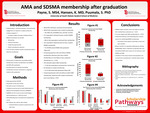
Results: In total, 438 (6.8%) physicians consented and participated. Overall, 296 (67.6%) indicated membership in a medical association in medical school; 101 only AMA, 38 only SDSMA, 133 both, and 24 only other. For the 234 with a student AMA membership, 71 (30.3%) continued; of the 171 with a student SDSMA membership, 88 (51.5%) continued. Comparing those with and without a student AMA membership, 21.0% without joined after graduation and 30.3% with continued (p = 0.07); for SDSMA memberships, 28.5% without joined after graduation, while 51.5% of those with continued (p = < 0.01). Common reasons for maintaining memberships included professional advocacy (n = 44) and educational opportunities (n = 32), for AMA and professional advocacy (n = 58) and networking (n = 45), for SDSMA. Common reasons for not joining after graduation include being part of a specialty medical group (n = 13) and AMA does not represent my specialty well (n = 7), for AMA, and being part of a specialty medical group (n = 11) and SDSMA does not represent my specialty well (n = 4), for SDSMA.
Conclusion: Those who were members of SDSMA as students were more likely to maintain their membership. This difference was less pronounced for AMA membership. Professional advocacy and networking were common reasons for maintaining SDSMA membership. Common reasons for not joining AMA and SDSMA memberships were feeling their specialty was not represented and being a member of a specialty medical group.
Recommended Citation
Payne, Sydney; Hansen, Keith; and Puumala, Susan, "AMA and SDSMA Membership After Graduation" (2026). Scholarship Pathways Program. 32.
https://red.library.usd.edu/spp/32