

Files
Download Full Text (443 KB)
Date of Presentation
5-7-2026
Document Type
Poster
Department
Medicine
Faculty Mentor
John P. Berdahl, MD, University of South Dakota Sanford School of Medicine & Vance Thompson Vision
Second Advisor
Tanner J. Ferguson, MD, University of South Dakota Sanford School of Medicine & Vance Thompson Vision
Keywords
visual acuity, lens replacement, Vivity IOL, LASIK, PRK
Subject Categories
Medicine and Health Sciences | Ophthalmology | Surgery
Abstract
Clinical outcomes of a non-diffractive extended depth of focus intraocular lens in post-refractive eyes
Collin Olevson, MD1 | John Berdahl, MD1,2 and Tanner Ferguson, MD1,2
1University of South Dakota Sanford School of Medicine, Vermillion, SD
2Vance Thompson Vision, Sioux Falls, SD
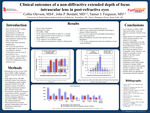
Introduction: Eyes with prior corneal refractive surgery (i.e laser-assisted in situ keratomileusis (LASIK) and photorefractive keratectomy (PRK)) pose challenges during cataract surgery due to altered corneal curvature. The AcrySof IQ Vivity intraocular lens (IOL) is a non-diffractive extended depth-of-focus (EDOF) IOL designed to provide a broader range of vision. Limited data exists on its performance in post-refractive eyes. This study evaluates visual, refractive, visual disturbances, and spectacle independence outcomes in eyes with previous LASIK or PRK implanted with the Vivity IOL following cataract surgery.
Methods: A retrospective review of eyes with a history of LASIK or PRK implanted with the Vivity IOL were included. Eyes with limited best corrected visual acuity post-operative were excluded. The study was approved by the University of South Dakota IRB. Postoperative uncorrected distance visual acuity (UDVA) and manifest refraction spherical equivalent (MRSE) at one month were collected. A phone-based survey assessed spectacle independence and visual disturbances. Primary outcomes included the proportion of eyes achieving 20/20 and 20/25 uncorrected distance visual acuity, the percentage within 0.5 diopters (D) of the refractive target, reported spectacle independence at distance, intermediate, and near, and the frequency and severity of visual disturbances.
Results: 42 eyes from 26 patients were included. Mean age was 63.5 years. 39 eyes had previous history of LASIK and 3 had history of PRK as primary refractive surgery. For eyes targeted emmetropic 45.2% achieved 20/20 or better and 76.2% achieved 20/25 or better UDVA. Mean MRSE was -0.23 D. 75.6% of eyes were within 0.5 D of refractive target. 11.9% of eyes underwent PRK enhancement following cataract surgery.
23 eyes from 14 patients responded to the survey. 100% of eyes experienced comfortable functioning all or most of the time without spectacles for distance vision and 65.2% of eyes experienced comfortable functioning all or most of the time without spectacles for near vision. 17.4% of eyes experienced one or more visual disturbance rated as moderate or severe.
Conclusion: Eyes with prior corneal refractive surgery achieved moderately successful visual and refractive outcomes with the Vivity IOL. In nearly half of the eyes UDVA was 20/20 or better and in three quarters of eyes refractive predictability within 0.5 D was achieved. Spectacle independence was high and bothersome visual disturbances occurred in less than one quarter of eyes. These findings suggest that non-diffractive EDOF IOLs can be a good option for appropriately selected patients with history of corneal refractive surgery.
Recommended Citation
Olevson, Collin; Berdahl, John P.; and Ferguson, Tanner J., "Clinical Outcomes of a Non-Diffractive Extended Depth of Focus Intraocular Lens in Post-Refractive Eyes" (2026). Scholarship Pathways Program. 27.
https://red.library.usd.edu/spp/27