

Files
Download Full Text (310 KB)
Date of Presentation
5-7-2026
Document Type
Poster
Department
Medicine
Faculty Mentor
Valeriy Kozmenko, MD, University of South Dakota Sanford School of Medicine
Second Advisor
Ethan Noble , University of South Dakota Sanford School of Medicine
Keywords
stress in the workplace, burn out, compassion fatigue, coping mechanisms, "smartest person in the room" syndrome
Subject Categories
Medical Education | Medicine and Health Sciences | Other Mental and Social Health
Abstract
Examining the relationships between work environment and stress coping mechanisms with burnout in medical students
Oluwafunke Ogunremi, MS4
Mentor: Valeriy Kozmenko, MD
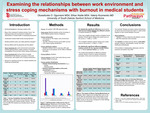
Introduction: Throughout the duration of medical training, learners are oftentimes overworked and faced with high levels of stress and pressure; this can decrease quality of life for many individuals.The goal of this study was to gain an understanding of how work environments and stress coping mechanisms play a role in the amount of burnout experienced by medical students. Burnout as defined by the Maslach’s Model, focuses on 3 key aspects: emotional exhaustion, depersonalization, and reduced personal accomplishments. Here, the authors focus on analyzing emotional exhaustion and reduced personal accomplishments.
Methods: This IRB approved study collected data from medical students at the University of South Dakota Sanford School of Medicine by using a 22 question Qualtrics survey. The Q12 survey by Gallup, Inc. was used to evaluate work environment perceptions, a question from the Mini Z Burnout Survey by the AMA was used to evaluate burnout, and a few questions pertaining to the CDC’s recommendations for healthy living were used to evaluate general stress coping mechanisms. A 5-point Likert scale was utilized for the survey questions. The survey remained open until at least a 50% response rate was achieved from the student body. The results of the survey were analyzed by using 2-sample t-tests and ANOVA tests as appropriate. The score on the survey was inversely related to burnout, so higher survey scores correlated to lower feelings of burnout.
Results: The questions were grouped according to intrinsic factors/coping mechanisms, such as eating and sleeping habits, and extrinsic factors/perception of the work environment, such as receiving recognition or having their opinion valued at work. There was a slightly stronger positive correlation found between intrinsic factors ratings and overall score on the survey (r = 0.868, p < 0.001) compared to the correlation between extrinsic factors and overall score on the survey (r = 0.849, p < 0.001). There was no significant difference between medical cohorts for the reported intrinsic factors (p = 0.745) or extrinsic factors (p = 0.876). Students who had healthier behaviors, such as following CDC recommendations or practicing meditation and mindfulness, had lower levels of burnout compared to those who did not.
Conclusion: Some medical students may recognize when they are burning out, so providing resources to help them incorporate healthier behaviors into their lifestyles may help aid burnout recovery. Finding effective ways to help students deal with stressors and develop coping mechanisms improves their own quality of life and can hence improve patient outcomes.
Recommended Citation
Ogunremi, Oluwafunke O.; Kozmenko, Valeriy; and Noble, Ethan, "Examining the Relationships Between Work Environment and Stress Coping Mechanisms With Burnout in Medical Students" (2026). Scholarship Pathways Program. 26.
https://red.library.usd.edu/spp/26