

Files
Download Full Text (1.8 MB)
Date of Presentation
5-7-2026
Document Type
Poster
Department
Medicine
Faculty Mentor
Jacob Miller, MD, University of South Dakota Sanford School of Medicine & Sanford Aberdeen Clinic, Sanford Health
Second Advisor
Jason C. Dorman, MS, Sanford Sports Performance, Sanford Health & Environmental Influences on Health and Disease Group, Sanford Research
Third Advisor
Thayne A. Munce, PhD, University of South Dakota Sanford School of Medicine & Environmental Influences on Health and Disease Group, Sanford Research
Keywords
head acceleration, whiplash, rodeo, Roughstock Riding
Subject Categories
Medicine and Health Sciences | Musculoskeletal Diseases | Nervous System Diseases | Wounds and Injuries
Abstract
Head Acceleration Events in Collegiate Rodeo Athletes
Colton Carlson, MS4
Mentor: Thayne Munce, PhD
Introduction: Brain health has been a growing concern across a wide range of contact sports in the last three decades. While most of the early brain health research was focused on identifying and preventing concussions, newer research has found that an accumulation of repetitive head impacts (RHI) is more predictive of long-term brain health than the number of concussions sustained. Consequently, being able to assess RHI in sports despite the lack of outward symptoms has become paramount in promoting the long-term health of athletes. While the sport of rodeo has long been regarded as one of the most dangerous sports in America, minimal research has been done in the sport regarding athlete safety. Current studies on rodeo are limited to minimal epidemiological research on injury rates that has largely backed up its dangerous reputation. Despite this, no further research has been done into head impacts in rodeo athletes.
Methods: Thirteen athletes competing in the “Roughstock” events of Bareback Riding, Saddle Bronc Riding and Bull Riding were recorded across five rodeo competitions sanctioned by the National Intercollegiate Rodeo Association. Head acceleration events (HAE) were measured using an instrumented mouthguard (iMG) (Prevent Biometrics, Inc; Edina, MN) consisting of a triaxial accelerometer and gyroscope housed within a rubber mouthguard. The iMG recorded information including peak linear acceleration, peak angular acceleration and location of HAE. HAE were included if they exceeded a 5 g linear acceleration threshold. All rides were videoed, and all included HAE were subsequently video verified and categorized based on mechanism of HAE.
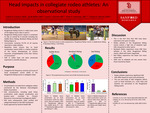
Results: A total of 112 rides were monitored across five collegiate rodeo competitions capturing 344 HAE. Bareback Riding (7 [4-10] HAE/ride) experienced a significantly higher (p < 0.001) median frequency of HAE than the other two events (1 [0-2] HAE/ride for each) however, median peak linear acceleration was significantly lower (p < 0.01) in Bareback Riding (8.7 [6.6-11.1] g) compared to Bull Riding (10.7 [8.4-15.5] g) and Saddle Bronc Riding (10.2 [8.9-13.9] g). Bull Riding and Saddle Bronc Riding HAE frequency and median peak linear acceleration were comparable to each other. Whiplash was the most common cause of HAE across events, outpacing direct caused of HAE such as impacts with the animal or impacts with the ground. Whiplash (8.9 [6.6-11.1] g) however resulted in a significantly lower (p < 0.001) median peak linear acceleration than impacts with the animal (10.7 [8.7-20.1] g) or impacts with the ground (11.4 [8.7-15.8] g).
Conclusions: Rodeo athletes across the Roughstock Events experience significant HAE throughout the course of competition. Athletes in Bareback Riding tend to experience a high volume of load magnitude HAE while athletes in Saddle Bronc Riding and Bull Riding experience fewer, higher magnitude HAE. Much of the HAE load is the result of whiplash type injury as opposed to direct impacts to the head which suggests that whiplash reducing measures such as neck rolls may be an option to reduce cumulative HAE load on athletes. Direct head impacts however still result in the highest magnitude HAE confirming the utility of helmets in athlete safety.
Recommended Citation
Carlson, Colton D.; Miller, Jacob; Dorman, Jason C.; Valentine, Verle D.; and Munce, Thayne A., "Head Impacts in Collegiate Rodeo Athletes: An Observational Study" (2026). Scholarship Pathways Program. 19.
https://red.library.usd.edu/spp/19
Included in
Musculoskeletal Diseases Commons, Nervous System Diseases Commons, Wounds and Injuries Commons