

Files
Download Full Text (874 KB)
Date of Presentation
5-7-2026
Document Type
Poster
Department
Medicine
Faculty Mentor
Victor Huber, PhD, University of South Dakota Sanford School of Medicine
Keywords
vaccination refusal, immunization, patient education, anti-vaccination, booklet, handout
Subject Categories
Community Health | Medicine and Health Sciences | Virus Diseases
Abstract
Addressing Vaccine Hesitancy with Patient Education
Belle Grady, MD | Mentor: Victor Huber, PhD
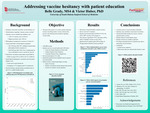
Background: Vaccine hesitancy is a complex global issue, exacerbated by pandemics and social media. In addition to hesitancy, state policies loosening childhood vaccine requirements and alternative vaccination schedules may contribute to recent vaccine-preventable illness outbreaks in the United States. In South Dakota alone, kindergarten vaccination rates have gradually declined over the past decade. Such vaccine hesitancy and decreasing vaccination rates is a public health concern and must be addressed. Accessible patient education resources on the topic are necessary to increase vaccination rates.
Project Description: This project consisted of three phases: a survey, information gathering, and booklet synthesis. A Qualtrics survey regarding vaccine hesitancy was posted on social media and in three South Dakota medical clinics to gather information on which vaccines and which aspects of vaccination patients were most concerned about. Guided by the survey results, information from reputable sources and peer-reviewed articles was gathered and utilized to create a patient education booklet for distribution in medical clinics. This project was IRB exempt.
Outcomes: The survey received 31 responses. According to survey participants, top vaccination concerns include ingredients, side effects, safety of receiving multiple vaccines at once, and pharmaceutical company gains. Vaccines participants feel most hesitant to receive or give their children are COVID-19, influenza, and HPV vaccines. The final 30-page patient education resource covered topics such as types of vaccinations, information on each routine childhood vaccine, the diseases vaccines protect against, and answers to common questions regarding vaccines. Local family medicine physicians and pediatricians welcomed the booklet as a resource for their patients.
Conclusion: This project has identified common causes of vaccine hesitancy in South Dakota which may be contributing to decreasing vaccination rates. An educational booklet containing information on routine vaccinations was produced to be distributed in South Dakota clinics. The goal of this resource is to increase vaccine confidence as well as decrease time spent discussing vaccine concerns during patient visits. The booklet will be available in print and pdf form. Although patient responses will not be collected after reading the resource, the information in the booklet provides answers to commonly asked questions about vaccines to decrease vaccine hesitancy.
Recommended Citation
Grady, Belle and Huber, Victor, "Addressing Vaccine Hesitancy with Patient Education" (2026). Scholarship Pathways Program. 20.
https://red.library.usd.edu/spp/20