

Files
Download Full Text (464 KB)
Date of Presentation
5-7-2026
Document Type
Poster
Department
Medicine
Faculty Mentor
Marcus L. Frohm MD, University of South Dakota Sanford School of Medicine
Keywords
diagnosis, biopsy, neoplasm, specialist, health care accessibility
Subject Categories
Dermatology | Medicine and Health Sciences | Skin and Connective Tissue Diseases
Abstract
Impact of Dermatology Access on Dermatofibrosarcoma Protuberans Outcomes
Joseph H. Kelly MD
Mentor: Marcus L. Frohm, MD
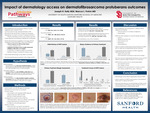
Introduction: Dermatofibrosarcoma protuberans is a locally aggressive rare dermal sarcoma with a relatively high rate of local recurrence. Incidence in the United States has been reported around 4 occurrences per million people per year, and recurrence rates have been reported between 2 to 19%. Recurrence poses a higher risk for sarcomatous transformation, increasing the risk for metastasis. Early and accurate diagnosis, coupled with appropriate management, is essential to minimize these risks. This study extended previous research by evaluating whether access to dermatology care influences dermatofibrosarcoma protuberans treatment outcomes in a larger cohort and larger geographical area.
Methods: This study was a retrospective review currently including 72 adults with histologically confirmed dermatofibrosarcoma protuberans. The first endpoint null hypothesis states the rate of pre-treatment biopsy does not differ between dermatology and non-dermatology providers. The second endpoint null hypothesis states the rate of peripheral and deep en face margin assessment or wide local excision with at least 2 cm margins does not differ between lesions with and without pre-treatment biopsy. The third endpoint null hypothesis states the rate of positive margins or primary recurrence does not differ between lesions with and without peripheral and deep en face margin assessment or wide local excision with 2 cm margins. The fisher exact test and chi-squared test with Yates correction were used in analysis.
Results: For all three endpoints, the data rejected the null hypothesis. Dermatologists had a higher rate of pre-treatment biopsy (P=.0053; OR=8.02[1.63,39.48]). Lesions with a pre-treatment biopsy had a higher rate of peripheral and deep en face margin assessment or wide local excision with at least 2 cm margins (P< .00001; OR=288[38.72, 2164.57]). Lesions that received peripheral and deep en face margin assessment or wide local excision with 2 cm margins had a lower rate of positive margins or recurrence (P< .00001; OR=39.6[8.69, 214.76]). Clinical tumor size did not independently impact endpoint 2 (P=.872; OR=1.04[0.40, 2.69]). Post-hoc analysis showed inappropriate primary treatment did not influence positive margins or recurrence after appropriate secondary treatment (P=.455; OR=2.55[0.47, 13.77]).
Conclusion: These findings support previous analysis of these endpoints with smaller sample sizes. Unlike previous results, this study suggests that access to dermatology affects the rates of pre-treatment biopsy on initial presentation. This study supports previous conclusions that diagnostic biopsy performed prior to treatment improves outcomes and decreases morbidity. Increased clinical awareness and appropriate biopsy or referral to dermatology for evaluation are recommended for suspicious lesions to improve the management of dermatofibrosarcoma protuberans.
Recommended Citation
Kelly, Joseph H. and Frohm, Marcus L., "Impact of Dermatology Access on Dermatofibrosarcoma Protuberans Outcomes" (2026). Scholarship Pathways Program. 21.
https://red.library.usd.edu/spp/21