


-
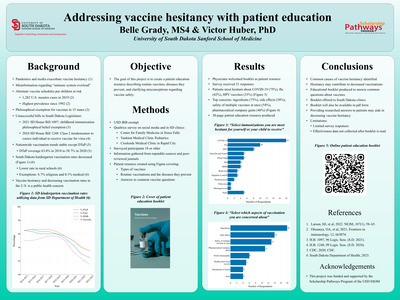
Minimizing Grief and Loss Through Advance Care Planning
Hannah Paauw and Victoria Walker
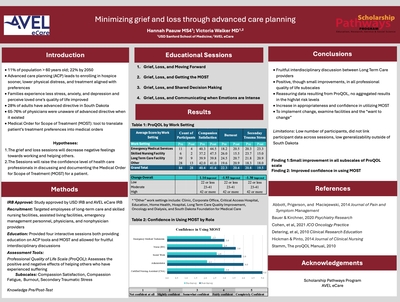
Advanced Care Planning (ACP) is a process used to identify or update a specific patient’s preferences of care and treatment in the event that they lack the capacity to do so. ACP is especially important for the aging population and those living with chronic conditions. Currently 11% of the world’s population is above the age of 60 and this number is projected to climb to 22% by 2050. The effects of aging are even greater in rural areas, such as South Dakota, where there is a disproportionate number of older and sicker people.
This study examined the effectiveness of a program designed to inform South Dakota health professionals about the uses and limitations of different ACP tools including Power of Attorney, Living Will, Comfort One, and MOST (Medical Orders for Scope of Treatment). Health care professionals who work with vulnerable adult populations were recruited through partnerships with long-term care organizations. Participants attended four one-hour long discussion-based sessions about grief, loss, and how it relates to ACP. Continued medical education credit was provided. The primary goals were to increase the comfort level of using ACP tools and help decrease the negative emotional impact on the health care professional. A pre/post knowledge survey and the Professional Quality of Life Scale are used to evaluate these measures.
Overall, the sessions increased the health care professionals’ comfort with using the ACP tools appropriately and increased professional well-being. Additionally, the sessions were well received and facilitated difficult discussions between professionals in various settings. The study was limited by the number of participants and participants who were not in attendance at all sessions. Further research on barriers to using ACP tools and outcomes of addressing these barriers could help with the overall usage of ACP in South Dakota. The use of implementation science in integrating these skills and tools into the clinical setting should be explored.
-
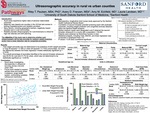
Ultrasonographic Accuracy in Rural vs Urban Counties
Riley T. Paulsen, Avery D. Franzen, Amy M. Eichfeld, and Laurie Landeen
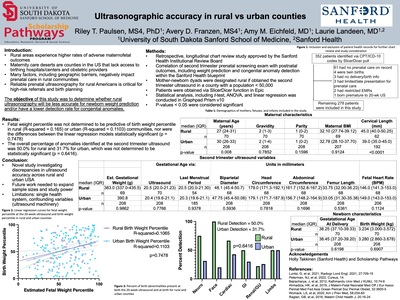
Background: Rural communities in the United States face significant barriers to prenatal care, including limited access to birthing facilities and obstetric providers. Accurate prenatal ultrasonography is essential for identifying congenital anomalies and predicting birth outcomes, particularly in these underserved areas.
Objective: This study aimed to evaluate whether ultrasonographic accuracy differs between rural and urban counties, specifically in predicting birth weight and detecting congenital anomalies.
Methods: A retrospective chart review was conducted using data from the Sanford Health system. Maternal and fetal data were collected from second trimester ultrasounds and compared with postnatal outcomes. Counties with populations under 50,000 were classified as rural. Statistical analyses included t-tests, ANOVA, and linear regression.
Results: Fetal weight percentile at the second trimester ultrasound was not predictive of birth weight percentile in either rural (R² = 0.165) or urban (R² = 0.1103) settings, with no significant difference between models (p = 0.7478). Anomaly detection rates were 50.0% in rural and 31.7% in urban counties, also not statistically significant (p = 0.6416). Maternal age and cervical length differed significantly between groups, but other variables showed no meaningful differences.
Conclusion: Ultrasonographic accuracy in predicting birth weight and detecting anomalies did not significantly differ between rural and urban counties. Further research with larger sample sizes and consideration of equipment variability is needed to validate these findings and improve prenatal care in rural settings.
-
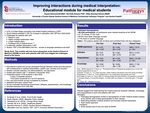
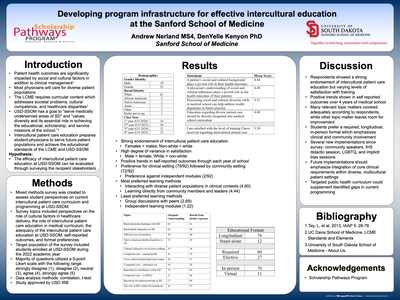
Improving Interactions During Medical Interpretation: Educational Module for Medical Students
Alyssa Reinschmidt, DenYelle Kenyon, and Hilda Sanchez-Herrera
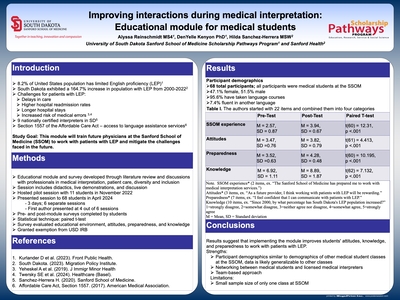
As the population of individuals with limited English proficiency (LEP) continues to grow in South Dakota and across the United States, healthcare systems face increasing challenges in providing equitable care. This study evaluates the implementation of an educational module designed to prepare first-year medical students at the University of South Dakota Sanford School of Medicine (SSOM) to work effectively with medical interpreters and patients with LEP. The module included a didactic session, role-play, open discussion, and pre- and post-surveys assessing students’ knowledge, attitudes, preparedness, and perceptions of the educational environment. Results from 68 participants demonstrated statistically significant improvements across all measured domains. Students reported increased confidence and understanding of interpreter roles, and feedback highlighted the value of incorporating virtual interpretation methods. The findings support the integration of formal interpretation training into medical curricula to enhance future physicians’ ability to deliver culturally and linguistically appropriate care.
-
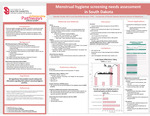
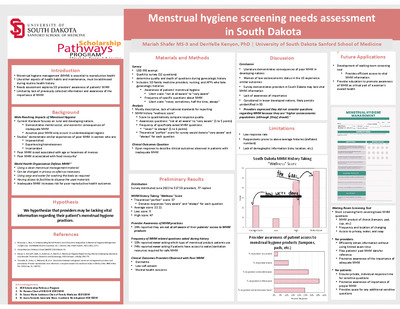
Menstrual Hygiene Screening Needs Assessment in South Dakota
Mariah M. Shafer and DenYelle Kenyon
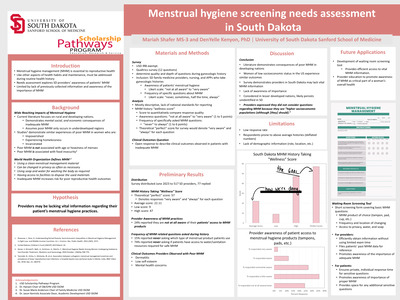
Introduction: Menstrual hygiene management (MHM) is essential to women’s reproductive health; literature demonstrates there are mental, social, and economic consequences to inadequate MHM in rural and developing countries. Emerging studies show that US women who are impoverished, experiencing homelessness, or incarcerated also face poor MHM. To understand the implications of poor MHM in South Dakota, a largely rural state, a thorough gynecologic health history is essential; this needs assessment explores the scope of MHM questions asked by SD providers.
Methods: This study used survey methodology to determine the quality and depth of gynecologic health histories commonly taken regarding hygiene. The electronic survey was sent to local primary care providers and nursing staff via email. The survey records the provider's awareness of their patients' menstrual hygiene, and the frequency of specific questions asked. The results of this needs-assessment led to the development of a waiting room screening tool that would allow providers efficient access to their patients’ MHM information.
Results: Providers’ (N = 70) awareness of MHM in South Dakota varied. The maximum score (57) denotes a respondent who selected “very aware” and “always” for each question. The average score was 22.11; scores ranged from 9 to 47. 24% said they were not at all aware of their patients’ access to MHM products. 74% report never asking their patients if they have access to adequate water and sanitation resources. 15% report never asking their patients which type of hygiene product they use.
Discussion: This needs assessment demonstrates providers may lack vital information with the potential to inform patient care. While poor MHM is considered in less developed nations, it persists unidentified in populations in South Dakota.
-
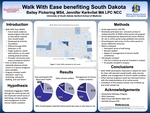
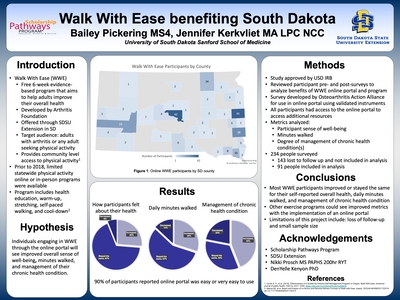
Walk With Ease Benefiting South Dakota
Bailey Thooft and Jennifer Kerkvliet
The Walk With Ease (WWE) program is a free, evidence-based, six-week walking initiative originally developed by the Arthritis Foundation to support adults with arthritis and other chronic conditions. This study evaluates the impact of WWE in South Dakota, focusing on participant outcomes related to overall health, physical activity, and chronic condition management. Participants engaged in either instructor-led or self-directed formats and accessed an online portal for resources. Pre- and post-surveys revealed that most participants improved or maintained their health metrics, with 44% reporting improved management of chronic conditions and 30% increasing daily walking time. The online portal was well-received, with 90% of users rating it as easy or very easy to use. Despite limitations such as a 61% loss to follow-up and a small sample size, the findings suggest that WWE, especially with digital support, can be a valuable tool for promoting physical activity and health management in rural populations like South Dakota’s. Future research should explore program fidelity and compare outcomes before and after the implementation of online resources.
-
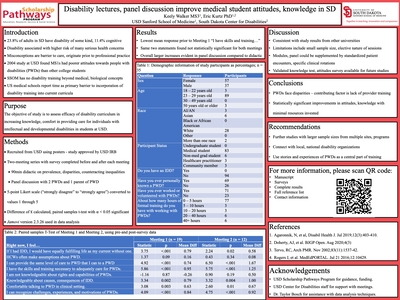
Disability Lectures, Panel Discussion Improve Medical Student Attitudes, Knowledge in SD
Keely Walker and Eric Kurtz
Despite growing recognition of persons with disabilities (PWDs) as an underserved population, healthcare disparities persist, often exacerbated by provider misconceptions and lack of training. This study evaluated the impact of a two-part educational module consisting of a didactic session and a panel discussion with individuals with disabilities focused on healthcare students’ knowledge and comfort in caring for patients with intellectual and developmental disabilities (IDDs). Conducted at the University of South Dakota, the sessions included pre- and post-surveys assessing attitudes, confidence, and perceived competencies. Results from 35 participants, primarily medical students, showed statistically significant improvements in 11 of 13 measured domains, including communication skills, understanding of disability experiences, and comfort discussing sensitive topics. The findings support the feasibility and effectiveness of brief, low-resource educational interventions in enhancing disability competency among future healthcare providers. The study highlights the importance of integrating disability education into medical curricula and suggests future directions for interdisciplinary and inclusive training.
-
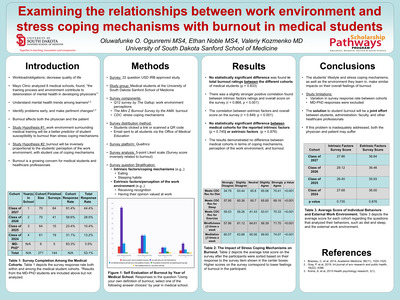
Examining the Relationships between Work Environment and Stress Coping Mechanisms with Burnout in Medical Students
Oluwafunke Oluwatosin Ogunremi
Introduction: Throughout the duration of medical training, learners are oftentimes overworked and faced with high levels of stress and pressure; this can decrease quality of life for many individuals. The goal of this study was to gain an understanding of how work environments and stress coping mechanisms play a role in the amount of burnout experienced by medical students.
Methods: Data was collected from medical students at the University of South Dakota Sanford School of Medicine by using a 22 question Qualtrics survey. The survey remained open until a 50% response rate was achieved from the student body. The results of the survey were analyzed by using 2 sample t-tests and ANOVA tests as appropriate.
Results: No statistically significant differences were found in total burnout ratings, coping mechanisms, and perception of the work environment between the different cohorts of medical students. Students who had healthier behaviors, such as following CDC recommendations on sleep, exercise, and fruit and vegetable consumption or practicing meditation and mindfulness, had lower levels of burnout compared to those who did not. Students who stated on the survey that they were experiencing burnout had a lower overall score on the survey, indicating higher levels of burnout.
Conclusion:Some medical students may recognize when they are burning out, so providing resources to help them incorporate healthier behaviors into their lifestyles may help aid in burnout recovery. Finding effective ways to help students deal with stressors and develop coping mechanisms improves their own quality of life and can hence improve patient outcomes.
The Scholarship Pathways Program is an elective opportunity that was developed to enrich the student experience by promoting rigorous independent scholarship and scholarly excellence at the USD Sanford School of Medicine. Students develop a mentored project with a focus on medical education, bench/translational research, service, or social science.
Printing is not supported at the primary Gallery Thumbnail page. Please first navigate to a specific Image before printing.